High Mileage Vehicle Checklist: Libertyville IL Guide

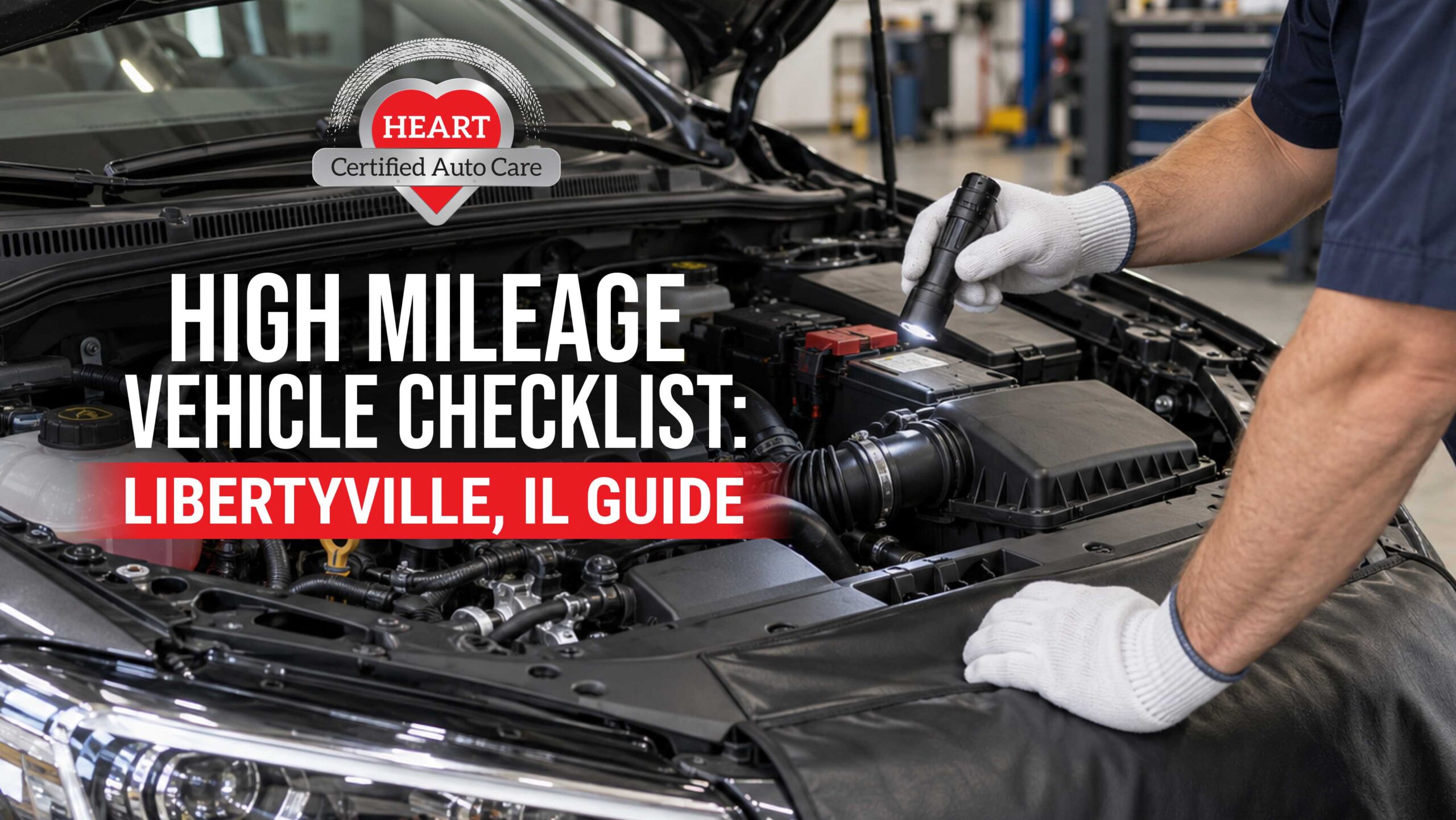
High mileage vehicle inspection at an auto repair shop in Libertyville IL

A high-mileage vehicle can still be a dependable daily driver, family SUV, or commuter. Reaching 100,000 miles does not automatically mean the vehicle is nearing the end of its life. It does mean that wear-related maintenance deserves closer attention.

This high-mileage vehicle checklist Libertyville IL drivers can use covers the systems that deserve attention as a vehicle passes 100,000 miles and continues toward 150,000 or 200,000 miles. The exact service schedule varies by make, model, engine, mileage, age, and driving conditions, so your owner’s manual should always be the final reference for scheduled maintenance.

TL;DR for Your High Mileage Vehicle Checklist Libertyville IL

  • Check the maintenance history – Before replacing parts, find out which major services have already been completed and which ones may have been missed.
  • Inspect fluids and filters – Oil, coolant, transmission fluid, brake fluid, and filters can affect reliability as the vehicle ages.
  • Look closely at brakes, tires, and suspension – Wear in these systems affects stopping, handling, ride quality, and tire life.
  • Review mileage-based services – Timing belts, spark plugs, belts, hoses, and other components may have specific replacement intervals.
  • Get a professional inspection – A thorough inspection can help you prioritize repairs instead of waiting for an aging component to fail.

What Counts as a High Mileage Vehicle

There is no universal mileage number that suddenly makes a vehicle “high mileage.” However, 100,000 miles is commonly considered an important maintenance milestone, and many modern vehicles can continue to run well beyond that point with proper care.

For a first-time car owner, the important point is simple: mileage alone does not tell you how healthy a vehicle is.

A 120,000-mile vehicle with consistent oil changes, documented repairs, and timely replacement of worn parts may be in better shape than an 80,000-mile vehicle that has missed years of maintenance.

Age also matters. Rubber components, seals, hoses, belts, fluids, and other parts can deteriorate with time even when the vehicle does not accumulate many miles.

That makes a complete inspection especially useful for drivers who recently purchased an older vehicle or who do not have complete service records.

High Mileage Vehicle Checklist Libertyville IL Drivers Should Follow

Your maintenance priorities should come from your vehicle’s service schedule and its current condition. The following checklist covers the major systems worth reviewing with a qualified technician.

1. Review the maintenance history

Start with the records before approving major work. This can prevent you from paying for a service that was recently completed.

  • Oil change history – Look for consistent oil and filter changes at the intervals recommended for your engine. A missing service record does not prove the service was skipped, but it is a reason to investigate further.
  • Major scheduled services – Check whether previous owners completed services such as spark plug replacement, transmission service, coolant replacement, or timing belt replacement when required.
  • Previous repairs – Look for recurring repairs involving brakes, suspension, cooling systems, electrical components, or oil leaks. Repeated repairs can reveal an underlying issue worth investigating.
  • Mileage at each service – Compare the mileage between visits rather than relying only on dates. This gives you a better idea of how frequently the vehicle was actually serviced.
  • Outstanding recommendations – If a previous inspection identified worn parts that were not repaired, ask a technician to check whether those items have become more urgent.

A service history gives you context, but it should not replace a current inspection. Parts continue to wear after the last documented service, so your vehicle’s present condition matters most.

2. Check engine oil and other fluids

Fluids perform several jobs, from reducing friction to controlling temperature and protecting hydraulic components. Their condition and service intervals vary by vehicle, so do not assume every fluid needs replacement simply because the odometer crossed 100,000 miles.

  • Engine oil – Confirm that the oil level and change interval match the manufacturer’s recommendations. Check for leaks if the oil level repeatedly drops between services.
  • Coolant – Inspect the coolant level and condition, along with the cooling system for leaks. An aging cooling system deserves attention because overheating can lead to expensive engine damage.
  • Transmission fluid – Follow the manufacturer’s service requirements for your transmission. If shifting becomes harsh, delayed, or inconsistent, have the system inspected rather than assuming fresh fluid will solve the problem.
  • Brake fluid – Brake fluid absorbs moisture over time, which can affect braking performance and corrosion protection. Ask about the manufacturer’s recommended replacement interval.
  • Power steering fluid – If your vehicle uses hydraulic power steering, inspect the fluid and system for leaks. Electric power steering systems do not use this type of fluid.

These checks form an important part of high mileage car maintenance in Libertyville IL, especially when a vehicle’s previous service history is incomplete.

3. Inspect belts, hoses, and timing components

Rubber and composite components can age even when the vehicle continues to run normally. A visual inspection can identify cracks, deterioration, leaks, or other warning signs before a component fails.

  • Serpentine belt – Look for cracking, glazing, fraying, or unusual wear. A damaged belt can affect accessories driven by the belt system.
  • Timing belt – If your engine uses a timing belt, check the manufacturer’s replacement interval and service history. Do not wait for a timing belt to show obvious symptoms before addressing a scheduled replacement.
  • Timing chain – Timing chains do not have the same routine replacement schedule as many timing belts, but chain systems can still develop wear or tensioner problems.
  • Coolant hoses – Inspect hoses for swelling, cracking, softness, or leaks. Heat cycles can gradually weaken them.
  • Drive belt tensioners and pulleys – Noisy or worn pulleys can contribute to belt problems. These components should be checked when the belt system is inspected.

Timing components deserve particular attention because the correct service interval depends heavily on the engine design. Your owner’s manual or manufacturer service information should guide the decision.

4. Inspect brakes and suspension

Brakes and suspension become increasingly important as a vehicle accumulates miles. Wear does not always appear as an obvious failure. Changes in steering, braking, ride quality, or tire wear can provide early clues.

  • Brake pads and rotors – Check remaining pad thickness and rotor condition. Uneven wear can point to caliper or other brake-system problems.
  • Brake lines and hoses – Look for corrosion, leaks, cracking, or other deterioration. This is particularly important on older vehicles.
  • Shocks and struts – Worn dampers can affect ride control and may contribute to uneven tire wear.
  • Ball joints and tie rods – These steering and suspension components should be checked for looseness or excessive play during an inspection.
  • Control arm bushings – Cracked or deteriorated bushings can contribute to clunks, vibration, steering changes, and uneven tire wear.

If your vehicle pulls during braking, vibrates through the steering wheel, clunks over bumps, or feels less stable than it used to, do not wait for the next routine service.

HEART Certified Auto Care provides brake and suspension services in Libertyville, along with inspections designed to identify problems before they become larger repair concerns.

5. Check tires, alignment, and wheel condition

Tires are one of the easiest high-mileage maintenance items to overlook because drivers often focus on the engine. Yet tire condition directly affects traction, braking, handling, and ride quality.

  • Tire pressure – Check pressure against the vehicle manufacturer’s recommended specification, usually listed on the driver’s doorjamb label. Do not rely on the maximum pressure printed on the tire sidewall.
  • Tread depth – Inspect tread regularly and look for uneven wear. A tire can have usable tread while still showing a problem with alignment or suspension.
  • Tire age – Check the date code and overall condition, particularly if the vehicle is driven infrequently.
  • Wheel alignment – Pulling, an off-center steering wheel, or uneven tire wear can indicate an alignment issue or another steering or suspension concern.
  • Wheel balance – Vibration at certain speeds can indicate an imbalance or another wheel and tire problem that needs inspection.

Tire maintenance becomes even more important when suspension components are aging. Fixing worn suspension or alignment problems can help prevent premature tire wear and improve how the vehicle feels on Libertyville roads.

6. Test the battery and charging system

A high-mileage vehicle may have gone through several batteries during its life, but that does not mean the current battery should be ignored.

  • Battery condition – Have the battery tested if it is older, slow to start, or showing signs of weakness.
  • Battery terminals – Check for corrosion or poor connections that could interfere with starting and charging.
  • Alternator output – If the battery repeatedly loses charge, the charging system needs evaluation rather than another battery replacement.
  • Starter performance – Slow cranking can point to a weak battery, starter issue, electrical resistance, or another problem.
  • Warning lights – Do not ignore a battery or charging-system warning light. Continuing to drive with a charging problem can leave you stranded.

Electrical problems can become frustrating when they are diagnosed by replacing parts one at a time. A proper electrical test can help identify the actual cause.

7. Check filters, spark plugs, and ignition components

Your engine depends on clean air, correct fuel delivery, and reliable ignition. Maintenance intervals vary by engine, but high-mileage service is a good time to confirm that these components are up to date.

  • Engine air filter – A restricted filter can reduce airflow to the engine. Replace it according to the manufacturer’s schedule or sooner if inspection shows excessive dirt.
  • Cabin air filter – A clogged cabin filter can reduce airflow through the HVAC system and make the blower work harder.
  • Spark plugs – Check the manufacturer’s replacement interval for your specific engine. Some modern plugs have long service intervals, but they still require inspection or replacement when specified.
  • Ignition coils – These usually are not replaced simply because the vehicle reaches a certain mileage. However, misfires, warning lights, or rough running should prompt testing.
  • Fuel system – If the vehicle develops poor acceleration, hard starts, rough idle, or reduced fuel economy, have the underlying cause diagnosed instead of automatically adding cleaning products.

A proper 100,000 mile service in Libertyville IL should be based on the manufacturer’s schedule and your vehicle’s actual condition, not a generic list of parts that every car supposedly needs.


oil change coupon details


oil change coupon details

What Should Be Checked at 150,000 Miles and Beyond

At 150,000 miles, the goal changes from checking one major milestone to managing the vehicle as an aging system. Components that were functioning well at 100,000 miles may now show more wear.

Your technician may pay particular attention to suspension components, steering parts, cooling-system components, seals, belts, hoses, exhaust components, and fluid leaks. Transmission performance also deserves attention, especially if shifting behavior has changed.

A 150,000-mile inspection can also help you decide which repairs deserve immediate attention and which can be planned for a later visit.

That distinction matters for vehicle owners who need to manage repair costs. A professional inspection can turn a long list of possible repairs into a prioritized plan.

Signs Your High Mileage Vehicle Needs Attention Now

Not every problem turns on a warning light. Pay attention to changes in how your vehicle starts, stops, handles, and sounds.

Watch for these warning signs

  • New fluid spots – Oil, coolant, transmission fluid, or other leaks should be identified before they become severe.
  • Unusual noises – Grinding, knocking, squealing, humming, or repeated clicking deserves a proper diagnosis.
  • Changes in braking – Pulling, vibration, grinding, a soft pedal, or longer stopping distances should not wait.
  • Steering changes – Excess play, pulling, vibration, or difficulty keeping the vehicle straight can point to steering, suspension, tire, or alignment problems.
  • Engine performance changes – Hard starting, rough idle, hesitation, stalling, or loss of power should be checked promptly.

These symptoms do not automatically mean you need an expensive repair. They are reasons to have the vehicle evaluated so you know what is actually happening.


heart team members with contact information

High Mileage Vehicle Care in Libertyville IL

A high-mileage vehicle does not need to be perfect to remain dependable. What matters is knowing which components need attention, keeping up with scheduled maintenance, and addressing warning signs before they turn into larger problems.

A practical high-mileage vehicle checklist Libertyville IL owners can follow starts with the service history, fluids, belts, brakes, tires, suspension, battery, and manufacturer-recommended mileage services. From there, an inspection can help you prioritize what needs attention now and what can wait.

If your vehicle is approaching 100,000 miles or has already passed that milestone, schedule an inspection with HEART Certified Auto Care. The team can help you understand your vehicle’s current condition and create a practical maintenance plan based on what your car actually needs.

HEART Certified Auto Care has convenient locations in Evanston, Wilmette, Northbrook, and Libertyville, so North Shore drivers can choose the location that works best for them.

Schedule service with HEART Certified Auto Care

author avatar
Akasha Qaiser

Auto Repair & Maintenance Near You

heart icon

Auto Repair That Actually Cares

heart icon

At HEART Certified Auto Care, we believe auto repair should feel honest, approachable, and stress-free — not confusing or intimidating. We’re not your typical repair shop. We take the time to explain what your car truly needs (and what it doesn’t), so you can make confident decisions without pressure.

Our experienced technicians focus on long-term vehicle health, preventative care, and clear communication. Whether you’re stopping in for routine maintenance or unexpected repairs, you’ll always be treated like family — with respect, transparency, and genuine care for your safety on the road.

With multiple convenient locations, HEART Certified Auto Care proudly serves drivers throughout Chicago’s North Shore and surrounding suburbs, providing dependable auto repair you can trust year after year.

Proudly Serving Local Communities Including:

Proud to Partner With Our Local Chambers of Commerce
Rooted in the Communities We Serve

What HEART Offers

Servicing Your Vehicle Has Never Been Easier

Icon representing 3 Year Warranty

3 Year Warranty

Icon representing Free Loaner Cars

Free Loaner Cars

Icon representing 98% Same Day Service

98% Same Day Service

Icon representing Transparent Pricing

Transparent Pricing

Icon representing Finance Options

Finance Options

Icon representing Certified Technicians

Certified Technicians

Icon representing Free Digital Inspection

Free Digital Inspection