


3 Year Warranty
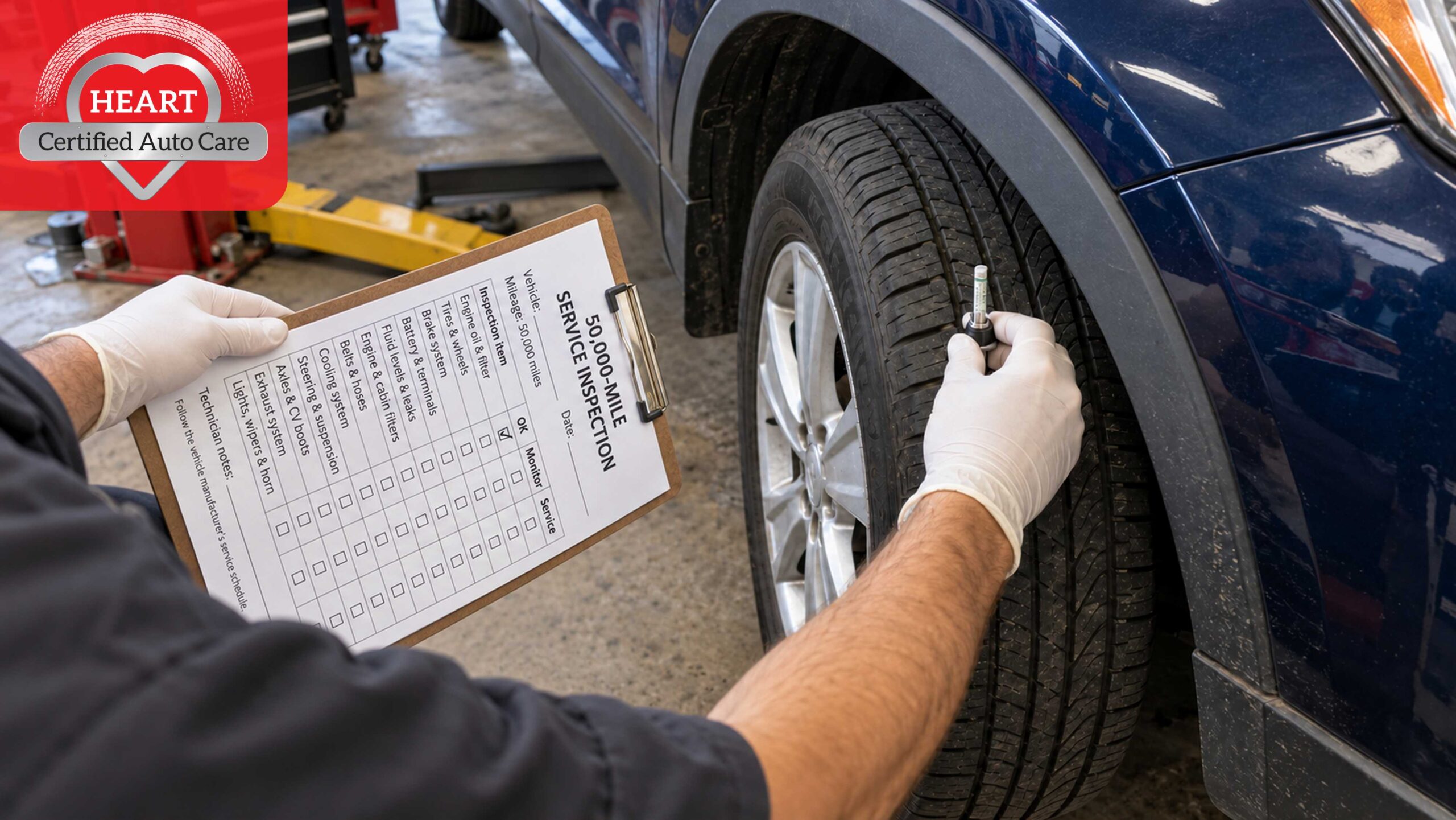
Reaching 50,000 miles is a good time to take a closer look at your vehicle. 50000-mile car maintenance can catch wear that routine oil changes may not reveal, including aging tires and brake components, fluid condition, filters, suspension parts, and battery performance.
There is no universal 50,000-mile service package for every car. Your owner’s manual remains the best source for the exact maintenance schedule because manufacturers use different service intervals. Still, 50,000 miles provides a useful checkpoint for a thorough inspection and for catching up on anything that may have been missed earlier.
The exact checklist depends on the vehicle, but a 50,000-mile visit should start with a review of scheduled maintenance and a careful inspection of components that affect safety, reliability, and drivability.
A useful 50,000-mile car maintenance checklist can include the following:
A proper 50,000-mile car maintenance checklist should therefore be treated as a starting point, not a list of automatic replacements. Your service history matters just as much as the odometer.
One of the most common mistakes first-time car owners make is assuming every vehicle needs the same parts replaced at this milestone.
Some manufacturers schedule specific services at 50,000 miles. Others place important maintenance at 45,000, 60,000, or another interval. For example, general maintenance guides commonly identify brake, tire, battery, suspension, and fluid checks around this mileage, while transmission service or filter replacement depends heavily on the vehicle.
Here are the items worth reviewing first:
The safest approach to car maintenance at 50,000 miles is to compare the manufacturer’s schedule with your actual service records. That prevents both maintenance omissions and unnecessary replacements.


| Maintenance Item | What to Check | Replace or Service at 50,000 Miles? | Why It Matters |
|---|---|---|---|
| Engine oil | Oil level, condition, leaks, and service interval | If due | Protects engine components and helps maintain proper lubrication |
| Oil filter | Filter condition and replacement interval | If due | Removes contaminants from engine oil |
| Engine air filter | Dirt, debris, restriction, and service interval | Inspect | A restricted filter can reduce proper airflow to the engine |
| Cabin air filter | Dirt, dust, odors, and airflow | Inspect | Helps maintain HVAC airflow and interior air quality |
| Tires | Tread depth, pressure, cracks, bulges, and uneven wear | Replace if worn | Proper tires support braking, handling, and road safety |
| Tire rotation | Wear pattern and rotation interval | If due | Helps promote more even tread wear |
| Wheel alignment | Steering pull and uneven tire wear | Check if needed | Incorrect alignment can cause premature tire wear |
| Brake pads or shoes | Thickness and wear | Replace if worn | Provides the friction needed to slow and stop the vehicle |
| Brake rotors or drums | Thickness, scoring, rust, and damage | Inspect | Damaged or worn braking surfaces can affect braking performance |
| Brake fluid | Level, condition, and manufacturer interval | If due | Proper fluid condition supports hydraulic brake performance |
| Brake lines and hoses | Leaks, cracks, corrosion, and damage | Inspect | Damaged components can compromise the brake system |
| Battery | Starting performance, terminals, and condition | Test | A weak battery can cause starting and electrical problems |
| Charging system | Alternator output and electrical performance | Test if needed | Helps confirm that the battery receives proper charging |
| Coolant | Level, condition, leaks, and service interval | If due | Helps regulate engine temperature and prevent overheating |
| Coolant hoses | Cracks, swelling, leaks, and deterioration | Inspect | Failed hoses can cause coolant loss and overheating |
| Transmission fluid | Level, condition, leaks, and service interval | If due | Proper fluid supports transmission operation |
| Transmission filter | Manufacturer service interval | If specified | Helps remove contaminants from transmission fluid |
| Spark plugs | Wear and manufacturer’s replacement interval | If due | Worn plugs can affect starting, combustion, and engine performance |
| Ignition components | Coils, wires where applicable, and connections | Inspect | Helps identify ignition problems and misfires |
| Belts | Cracks, fraying, glazing, and tension | Inspect | A failed belt can disable important engine accessories |
| Power steering fluid | Level, leaks, and condition where applicable | If due | Helps maintain proper steering-system operation |
| Steering components | Tie rods, ball joints, rack, and related parts | Inspect | Wear can affect steering control and tire wear |
| Suspension | Shocks, struts, bushings, and mounts | Inspect | Worn suspension can affect handling, comfort, and tire wear |
| CV joints and boots | Cracks, grease leaks, and damage | Inspect | Damaged boots can allow contamination and lead to joint failure |
| Driveshaft | U-joints, couplings, and damage where applicable | Inspect | Helps identify driveline wear and vibration |
| Exhaust system | Leaks, rust, damage, and mounting points | Inspect | Exhaust problems can affect emissions, noise, and safety |
| Fuel system | Leaks, lines, and scheduled filter service | Inspect | Helps maintain reliable fuel delivery |
| Wiper blades | Cracks, streaking, and deterioration | Replace if worn | Clear visibility is important in rain and poor weather |
| Windshield washer system | Fluid, spray pattern, and leaks | Check | Keeps the windshield clear when driving |
| Headlights | Low beams, high beams, and alignment | Inspect | Proper lighting improves nighttime visibility |
| Brake lights | Operation and condition | Inspect | Lets following drivers know when you are slowing |
| Turn signals | Front and rear operation | Inspect | Proper signals communicate your intentions to other drivers |
| Hazard lights | Operation | Inspect | Provides an important warning signal during emergencies |
| HVAC system | Heating, cooling, airflow, and unusual odors | Inspect | Helps identify cooling or heating problems early |
| A/C system | Cooling performance and leaks | Inspect if needed | Helps maintain reliable cabin cooling |
| Vehicle fluids | Oil, coolant, brake, transmission, and other applicable fluids | Check | Correct fluid levels help prevent mechanical problems |
| Undercarriage | Leaks, corrosion, damage, and loose components | Inspect | Can reveal problems that are difficult to see from above |
| Check engine light | Warning lights and stored diagnostic codes | Scan if applicable | Can identify electronic or emissions-related problems |
| Maintenance records | Previous repairs and completed services | Review | Prevents unnecessary duplicate maintenance |
| Manufacturer schedule | Required 50,000-mile services | Review | The owner’s manual determines vehicle-specific service intervals |
Important: This table works best as a general 50,000-mile car maintenance checklist, not as a universal replacement schedule. Some items may be due before 50,000 miles, some at 50,000 miles, and others considerably later. Always compare the checklist with the maintenance schedule for the exact year, make, model, engine, and driving conditions.
Before approving a long list of repairs, find out what has already been completed. This step can save money and give a technician a much clearer picture of your vehicle.
For car maintenance at 50,000 miles, gather:
A good shop should be able to explain what your car needs now and what can wait. If a service was completed recently, you should not need to pay for it again simply because the odometer reached a round number.

Reaching 50,000 miles gives you a useful opportunity to review your vehicle’s maintenance history and inspect the systems that matter most for safe, reliable driving.
The biggest takeaway is simple: do not treat 50,000 miles as a universal parts-replacement deadline. Start with your owner’s manual, review previous service, then have the vehicle inspected based on its actual condition.
For drivers in Evanston, Wilmette, Northbrook, Libertyville, and surrounding North Shore communities, HEART Certified Auto Care offers scheduled maintenance and vehicle inspections at its local shops. Its team can help identify current concerns while giving you a clearer idea of what your vehicle may need next.
If your odometer is approaching 50,000 miles, this is a good time to review your maintenance records and schedule an inspection. HEART Certified Auto Care has locations in Evanston, Wilmette, Northbrook, and Libertyville, making it convenient for local drivers to find a nearby shop.
Visit HEART Certified Auto Care to schedule an appointment and discuss your vehicle’s 50,000-mile maintenance needs.


At HEART Certified Auto Care, we believe auto repair should feel honest, approachable, and stress-free — not confusing or intimidating. We’re not your typical repair shop. We take the time to explain what your car truly needs (and what it doesn’t), so you can make confident decisions without pressure.
Our experienced technicians focus on long-term vehicle health, preventative care, and clear communication. Whether you’re stopping in for routine maintenance or unexpected repairs, you’ll always be treated like family — with respect, transparency, and genuine care for your safety on the road.
With multiple convenient locations, HEART Certified Auto Care proudly serves drivers throughout Chicago’s North Shore and surrounding suburbs, providing dependable auto repair you can trust year after year.
Proudly Serving Local Communities Including:
Looking for dependable auto repair near you? Schedule an appointment with HEART Certified Auto Care today and experience the difference of local service done right.





Servicing Your Vehicle Has Never Been Easier
3 Year Warranty
Free Loaner Cars

98% Same Day Service

Transparent Pricing

Finance Options

Certified Technicians
Free Digital Inspection